14 off the beaten path places in France you will love
Everybody goes to Paris. Then Nice, then Mont Saint-Michel, then home. And that is fine, those places are famous for a reason. But France is huge and most of it is empty, and the empty parts are where the trip gets interesting.
France receives close to 100 million international visitors a year according to the national tourism figures, and almost all of them squeeze into the same handful of spots. Which means that two hours away from the crowds you can have a whole valley to yourself, pay half the price for a room, and eat better food than in any tourist restaurant on the coast.
So here are 14 off the beaten path places in France that most tourists never hear about. Some of them are villages, some are whole regions. All of them are worth your time.
First things first: how do you even get to these places?
This is the part nobody talks about, and it is the reason most people give up and go back to the Riviera.
Off the beaten path in France means off the train line. The TGV is brilliant between big cities and useless everywhere else. Some of the places on this list have no station at all, and the ones that do might get three buses a day.
You have three options.
Rent a car. The obvious one. Roads are excellent and empty, fuel is expensive, and parking in the villages is usually free. If you are two or more people, this is the cheapest way.
Train plus bus plus patience. It works, but you need to plan around timetables and you will lose half a day here and there. Check the regional TER network rather than the national one, and remember buses often do not run on Sundays.
Walk between them. This one surprises people. France has more than 113,000 km of waymarked long-distance paths, and a lot of them link exactly the kind of villages on this list. You walk from one to the next in a day, sleep there, carry on. Agencies that organise walking holidays in France book the rooms ahead of you and move your bag between stops, so you only carry a daypack. It is slower than driving, obviously. But if the whole point of your trip is to see the quiet parts of the country, arriving on foot is not the worst way to do it.
14 off the beaten path places in France
1. The Aubrac plateau
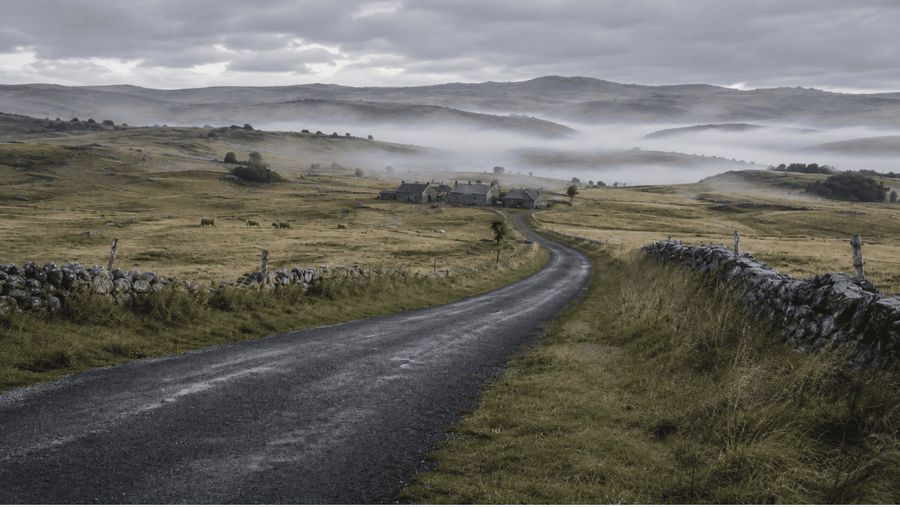
A high, treeless plateau where Aveyron, Lozère and Cantal meet. Cows, granite, wind, and almost nothing else. In spring the whole thing turns into a wildflower meadow and in winter it looks like Iceland.
The village of Aubrac itself is basically three buildings and a twelfth century tower. Eat aligot, which is mashed potato beaten with fresh cheese until it stretches like melted mozzarella. It sounds strange and it is fantastic.
Very few foreign tourists come here. The ones who do are usually walking through, because the old pilgrim route from Le Puy-en-Velay crosses the whole plateau on its way to Conques.
2. Conques
If you only pick one village from this list, pick this one. Conques sits in a steep wooded gorge in Aveyron, all slate roofs and half-timbered houses, built around an abbey church from the eleventh century.
The reason to go is the tympanum above the door: 124 carved figures showing the Last Judgement, still with traces of the original paint. And inside, a small gold statue holding the relics of Saint Foy, encrusted with gems and cameos donated by pilgrims over the centuries. The relics themselves were stolen from Agen by a monk of Conques in the ninth century, which is a story the village is not shy about.
Go in the evening when the coaches have left and the village empties out completely. Evening visits of the abbey run in season and are worth checking when you arrive.
3. The Jura mountains
Everybody knows the Alps. Almost nobody outside France knows the Jura, which is the smaller, greener, much quieter range along the Swiss border.
Go for the Cascades du Hérisson, a series of waterfalls you walk up through the forest, and for the lakes around Clairvaux and Chalain, which are properly swimmable in summer. The local wine is weird and wonderful, especially vin jaune, which is aged under a film of yeast for six years.
Prices here are a fraction of what you pay in Chamonix.
4. Côte de Granit Rose, Brittany
A stretch of the north Brittany coast where the rocks are genuinely pink. Not pinkish, pink. They are granite boulders the size of houses, piled up along the shore in shapes that look like animals and faces.
The best bit is the coastal path between Perros-Guirec and Ploumanac’h, about an hour of easy walking with a lighthouse at the end. Go at sunset when the light makes the rocks glow.
Brittany weather does what it wants, so bring a jacket even in August.
5. The Camargue
Between Arles and the Mediterranean there is a huge flat wetland of salt marshes and lagoons where white horses and black bulls run semi-wild and thousands of pink flamingos stand around in the shallows.
It feels nothing like the rest of Provence. No hilltop villages, no lavender, just enormous skies and a lot of birds. Rent a bike in Saintes-Maries-de-la-Mer and ride the dykes.
Bring mosquito repellent. I am not joking about this one.
6. Les Orgues at Ille-sur-Têt
In the Pyrénées-Orientales, near Perpignan, water has eroded a hillside of clay and sand into a forest of pale pillars up to twelve metres high. They look like something from Cappadocia or Utah dropped into the south of France.
The site is small and takes about an hour. Go early or late, because there is no shade at all and the middle of the day in summer is brutal.
7. Villefranche-de-Conflent
Twenty minutes away, a tiny fortified town squeezed into a river gorge, walled by Vauban in the seventeenth century and now on the UNESCO list. You can walk the entire ramparts in half an hour.
From here you can also catch the Train Jaune, a little open-sided yellow train that climbs into the high Pyrenees. It is one of the best train rides in Europe and hardly anyone talks about it.
8. The Cévennes
A national park of granite ridges, chestnut forests and deep valleys in the south of the Massif Central, with more than a few abandoned hamlets being slowly brought back to life.
Robert Louis Stevenson walked across it with a donkey in the 1870s and wrote a book about it, and you can still follow his route. Mont Lozère is bare and windswept at the top and looks like nowhere else in France.
This is properly rural. Shops close at lunchtime, some villages have none at all, and that is exactly the point.
9. Le Puy-en-Velay
A town built among volcanic plugs in the Auvergne, with a chapel perched on top of one of them. You climb 268 steps cut into the rock to reach it.
The cathedral is a strange mix of Romanesque and Moorish architecture, and the whole old town is worth a slow morning. It has been a gathering point for walkers heading to Spain for over a thousand years, and it is still where the main French route starts. If you have been reading this list and wondering which places you could link on foot, the answer is Le Puy, then the Aubrac, then Conques, then the Lot valley, all on the same waymarked path.
The local speciality is green lentils with a protected origin label, which sounds boring and tastes brilliant.
10. Chaîne des Puys, Auvergne
A line of about eighty extinct volcanoes running north to south near Clermont-Ferrand, added to the UNESCO list in 2018. You can climb most of them in an hour or two.
Puy de Dôme is the famous one and has a rack railway to the top. Puy de Sancy, further south, is the highest point in central France at 1,885 m and has a proper ridge walk. In between, dozens of smaller cones with nobody on them.
Add the crater lakes, like Lac Pavin, which is almost perfectly round and very deep.
11. Saint-Cirq-Lapopie and the Lot valley
A medieval village stuck to a cliff 100 metres above the Lot river, with the ruins of a castle on top. It was voted the favourite village of the French a few years back, so it is not a secret anymore, but the valley around it still is.
Follow the river west towards Cahors and you get limestone cliffs, tiny wine estates making very dark red wine from Malbec, and the Chemin de Halage, a towpath carved directly into the rock face.
12. The Vercors
A limestone plateau south of Grenoble, ringed by cliffs, with only a handful of roads going in. Some of those roads are tunnels and balconies cut into vertical rock, which is an experience in itself.
The Gorges de la Bourne are spectacular. So is the Combe Laval road, if you have a head for heights. There is also a lot of history here, because the Vercors was a centre of the French Resistance and there are memorials all over the plateau.
13. Baie de Somme
Two hours north of Paris and almost never visited by foreigners. A huge tidal bay where the sea goes out for kilometres and comes back fast, with one of the biggest colonies of harbour seals in France.
Saint-Valery-sur-Somme is a pretty medieval port, there is a little steam train around the bay, and the birdwatching at Marquenterre is excellent. Guided walks take you out onto the sands, and please do not go out there alone, the tide is genuinely dangerous.
14. Montségur and Cathar country
In the Ariège, in the foothills of the Pyrenees, a ruined castle sits on a rock spike at 1,200 m. In 1244 more than 200 Cathars were burned alive at the bottom of it after a ten month siege.
The climb takes about half an hour and it is steep. The view from the top is enormous, and the place has an atmosphere that is hard to describe. There is a whole trail of these castles across the region, most of them free to visit and empty.
Off the beaten path in the south of France
If you are set on the south, you can still avoid the crowds. Skip Nice, Cannes and Saint-Tropez in August and go inland instead.
The Ariège and the Cathar castles, as above. The Aveyron, with Conques and the gorges of the Tarn. The Corbières, a dry hilly wine region between Carcassonne and the sea where nothing much happens. The Vallée de la Roya behind Menton, with its Bronze Age rock carvings.
Same weather, same food, a third of the people.
Off the beaten path near Paris
You do not have to cross the country either. Within two hours of Paris there is the Baie de Somme, the forest and sandstone boulders of Fontainebleau, the chalk valleys of the Vexin, and the Champagne côte des Bar in the south of the region, where the small growers are and the prices are not insane.
All of them reachable by train, which makes them the easiest option on this whole page.
When to go
September, without hesitation. The weather is still good, French school holidays are over, everything is open, and prices drop.
May and June are the second best, especially for the mountains and the wildflowers, though some things in rural areas do not open until later.
Avoid the first three weeks of August. That is when the whole country is on holiday at the same time, and the quiet places are suddenly not that quiet.
Winter is beautiful in the Cévennes and the Auvergne but a lot of small hotels and restaurants simply close, so check before you go.
Practical things worth knowing
Shops close at lunch. Between noon and two, rural France stops. Buy your food before, or go hungry.
Sunday is dead. Bakeries open in the morning, everything else does not. Plan around it.
Cash still matters. Small village bakeries, markets and some gîtes either do not take cards or have unreliable connections.
Learn ten words of French. In Paris everyone speaks English. In a village in the Aubrac, nobody does, and a bonjour before you say anything else changes the whole interaction.
Book ahead in tiny places. A village with two guesthouses fills up fast in summer, and the next bed might be 40 km away.
Off the beaten path France FAQ
What is the most underrated region in France?
The Aubrac plateau and the wider Aveyron are probably the least visited beautiful parts of the country. Huge open landscapes, medieval villages like Conques, excellent food and almost no foreign tourism, all within a few hours of Toulouse or Lyon.
Where in France has the fewest tourists?
The rural centre. Cantal, Lozère, Creuse, Ariège and the Aveyron all have very low population density and almost no international visitors. The Baie de Somme in the north is another one, despite being two hours from Paris.
Do I need a car to travel off the beaten path in France?
It is the easiest option, but not the only one. Regional TER trains reach a surprising number of small towns, and long-distance footpaths link many of the villages on this list, which is why walking from one to the next is a genuine alternative in some regions.
Is off the beaten path France expensive?
No, it is much cheaper than Paris or the Riviera. Guesthouses in rural areas often cost half of what you pay on the coast, restaurant set menus are good value, and many of the best things to see, like villages, castles and walking trails, are free.
What is the best month to visit rural France?
September. Warm weather, harvest season, everything still open and far fewer people. May and June come next. Avoid the first three weeks of August, when the whole of France is on holiday.
Which off the beaten path places in France are good for a first trip?
Start with the Jura, the Baie de Somme or the Chaîne des Puys. All three are easy to reach, have decent infrastructure, and give you the empty-countryside feeling without needing much planning.